University of New Haven President: ‘Saudi Arabia is an extraordinary frontier in the evolution of global education’
Becoming the first institution in the world to receive approval to establish an international branch campus in Saudi Arabia builds on the University’s longstanding commitment to supporting education around the globe.
January 9, 2026
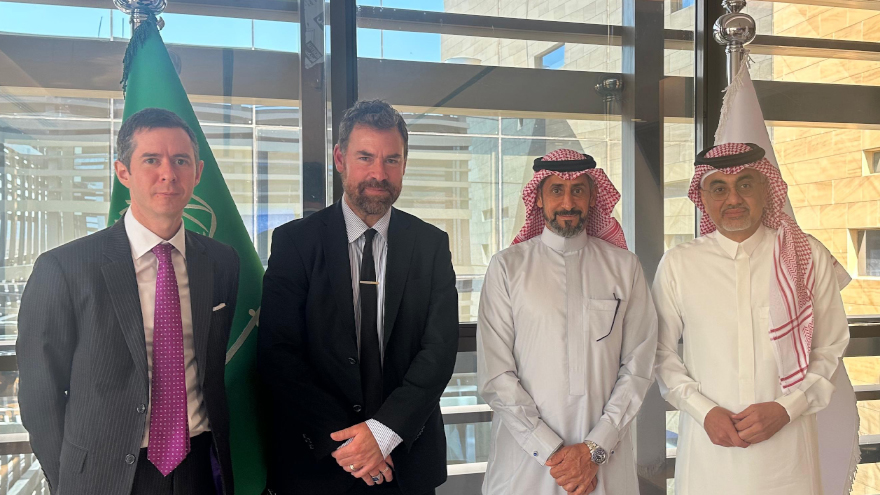
(L-R) Leo Lester, Ph.D, Executive Director, Middle East, and President Frederiksen with Badr AlBadr, CEO of the Misk Foundation, and Omar Najjar, Deputy Chief Executive Officer of the Misk Foundation.
One of the reasons Jens Frederiksen, Ph.D., was attracted to the University of New Haven’s open presidency in the Fall of 2023 was the University’s impressive international profile.
Not only was there a large number of international students on its Connecticut campus, including from Saudi Arabia, there was also a satellite campus in Italy and a host of ongoing projects around the world. The University was also unique in that it maintained a team in Riyadh to develop and consult on curricular design and program delivery, building on its active support of higher education in Saudi Arabia for more than 20 years.
Dr. Frederiksen quickly determined it was imperative to visit Saudi Arabia soon after he was named the University’s seventh president in March 2024.
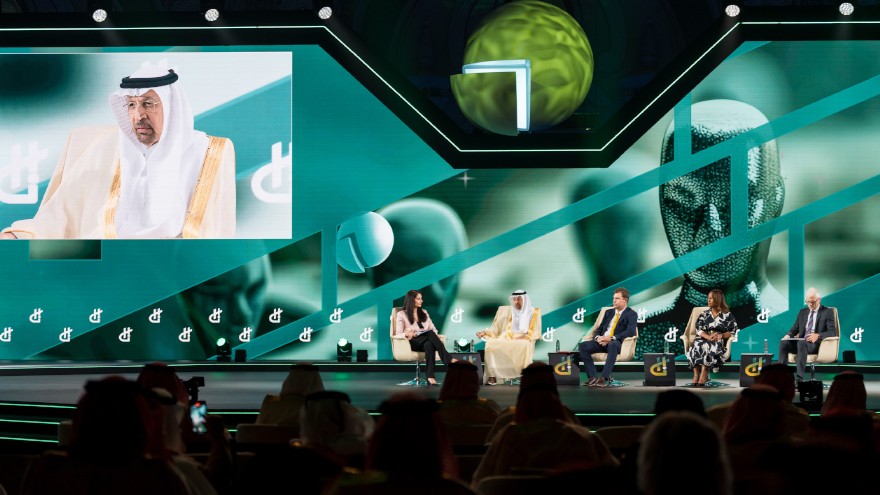
President Frederiksen participates in a panel discussion at the 2025 Human Capability Initiative in Riyadh.
“From my first visit to Saudi Arabia, it was clear that the Kingdom was transforming at an unprecedented speed and scale,” said he said. “Vision 2030 continues to deliver unparalleled change, and in some instances, even surpassing its own bold objectives, including raising female participation in the work force from 22% to 36%. Entire sectors are evolving, and more and more U.S. companies are locating their regional headquarters to Riyadh. The demand for top talent is palpable, and quality higher education is becoming the crucible for a knowledge-based workforce that will sustain the Vision 2030’s objectives and realize the next generation of bold developments.”
A little over a year after President Frederiksen’s arrival, the University signed a memorandum of understanding with Saudi Arabia's Ministry of Education, its Ministry of Investment, and the Royal Commission for Riyadh City, creating a pathway for the University to open a campus in Riyadh. In October 2025, the University became the first in the world to receive approval to open an international branch campus in the Kingdom in Fall 2026, pending final regulatory approval.
“From our first ministerial meetings in Saudi Arabia, it was clear that there is pressing desire for market-responsive and market-defining programs – like the ones the University delivers in Connecticut,” said President Frederiksen. “The Ministry of Education has been highly supportive throughout the process, and every Ministry has stressed the exponential importance of both higher and continuing education to the goals of Vision 2030 and the Kingdom’s future.
“The emphasis Saudi Arabia is placing on education is tremendously exciting,” continued President Frederiksen. “There is an opportunity for us to contribute in a hugely impactful way. Our model of experiential learning and focus on making graduates ‘better than ready’ for the workplace of the future resonates deeply in the Kingdom.”
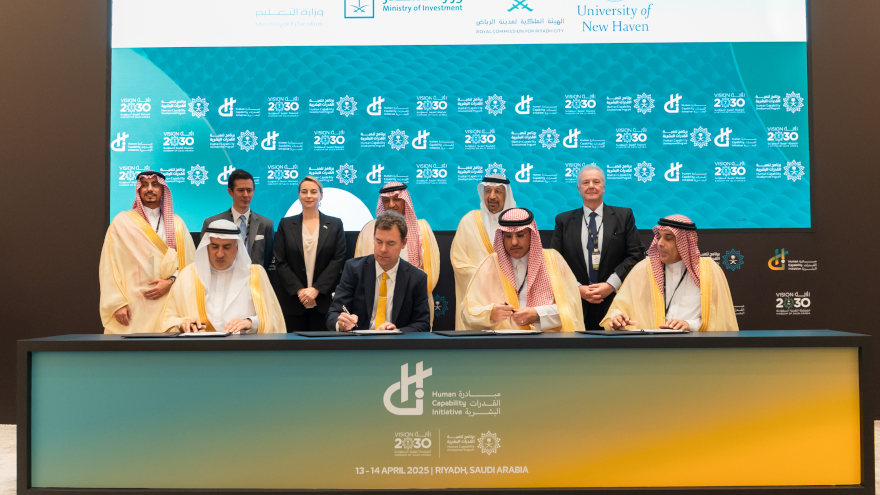
President Frederiksen and Saudi leaders sign an MOU at the Human Capability Initiative in April 2025 creating a pathway for the University to become the first in the world to open an international branch campus in Riyadh.
Within the next 10 years, University of New Haven – Riyadh is projected be home to approximately 13,000 undergraduates and graduates. The Riyadh campus will be built around three colleges: Business and Digital Innovation, Arts and Applied Sciences, and Engineering and Advanced Manufacturing. The first majors to be opened will be in Business Management, Sport Management, Esports, and Marketing. An MBA program is also planned.
“The University of New Haven is committed to being at the forefront of educating the elite global workforce of the future,” continued President Frederiksen. “As Saudi Arabia reimagines its higher education sector we are excited to be leading the charge.”
Ultimately, President Frederiksen says, it is the key forces identified in Vision 2030 that compel an expansion in higher education – significant population growth, the inability for the growing population to secure enrollment in existing universities and, a developing private sector higher education ecosystem – creating the most potential for the University of New Haven to make a lasting impact in the Kingdom, across the region, and around the world.
“These are unprecedented times in higher education, and the temptation of many is to turn inward,” said President Frederiksen. “But the University of New Haven is seizing this moment to expand globally and revitalize its traditional educational value in response to a rapidly evolving economic, social and global landscape. Saudi Arabia is an extraordinary frontier in the evolution of global education, and the University of New Haven is excited to be leading the charge to partner with the Kingdom.”